A quoted pulley price is incomplete until you know whether it covers the pulley, bush or keyless locking device, machining, taxes and delivery. By the end, you will have a specification checklist, a torque-based selection method and a way to compare complete quotations for a usable assembly.
Key takeaways
- Request the pulley, bushing and fasteners as one complete assembly.
- Provide bore, shaft, belt profile, pitch diameter and transmitted power.
- Choose Power Lock, Taper Lock, keyed hub or shrink disc by torque and access.
- Check shaft tolerance, key fit, tightening torque and runout before installation.
What a Coimbatore pulley quotation should include
A quoted price is comparable only when it covers an identifiable complete assembly. For a Power Lock taper lock pulley price in Coimbatore, the bore and locking arrangement often change the figure more than the pulley’s outside diameter.
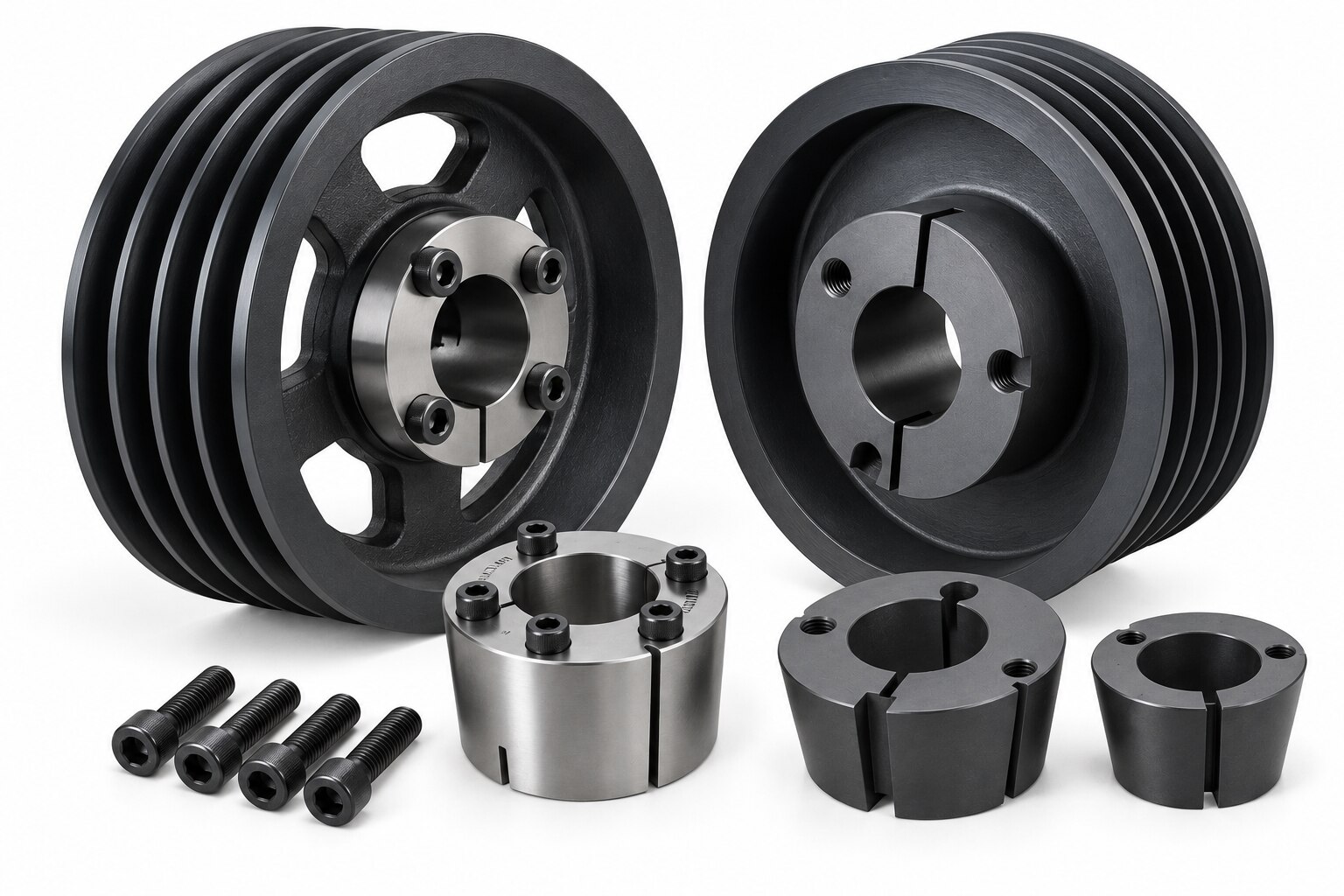
A taper lock pulley supplier should identify whether the offer contains a split taper bush or a keyless Power Lock device; these are different connection systems.
Ask the supplier to state each item:
- Grooved pulley part number, belt profile, pitch diameter, number of grooves, face width and material
- Taper bush part number and shaft bore, or the exact Power Lock device model
- Key and fixing screws, stating “included” or “excluded”
- Bore machining, hub modification and dynamic balancing requirements
- Transmitted power or torque, operating speed and service factor used for selection
- GST rate, freight to your Coimbatore delivery address, packing and installation charges
- Delivery date, warranty, stock status and whether the price is per pulley or per complete set
| Price difference | What the lower quote may omit | What to compare |
|---|---|---|
| Pulley only | Bush or locking device, key and screws | Complete pulley-and-connection assembly |
| Standard bore | Custom bore, hub machining or balancing | Shaft diameter, tolerance and finished bore |
| Ex-works price | GST, freight, packing or installation | Delivered price with taxes shown |
| “Lock pulley” listing | Taper bush supplied instead of Power Lock, or no device | Locking principle and matching part numbers |
A bush with the correct shaft bore but the wrong pulley hub taper is not a valid substitute. A bare “power lock pulley price” cannot establish like-for-like value.
The dimensions and belt details needed for a valid price
A shaft diameter alone cannot produce a valid pulley quote. A request to buy power lock pulley in coimbatore is a specification-and-stock enquiry: the supplier must match the belt, hub and locking device as one assembly.
Send these details:
- Shaft diameter, fit tolerance, usable shaft length, keyway width and depth, and any shoulder or thread that limits hub position.
- Pulley pitch diameter or outside diameter, number of grooves, groove profile, face width, hub outside diameter and hub length.
- Belt designation, such as SPB, 5V, A-section, HTD 8M or a named timing-belt pitch; include belt width and number of belts where relevant.
- Pulley material, operating speed in rpm, transmitted power in kW or torque in N·m, starts per hour, reversing, shock loading and service factor.
- Connection choice: split Taper Lock bush, keyless Power Lock device, keyed bore or shrink disc. Give the required model if replacing an existing part.
| Detail | Send | Why it changes the quote |
|---|---|---|
| Bore | Finished bore and tolerance | Determines machining and locking-device size |
| Hub | Taper series, length and diameter | A correct bore with the wrong hub taper will not fit |
| Belt geometry | Profile, pitch diameter, grooves and width | Prevents belt seating and speed errors |
| Operating duty | Speed, power or torque and shock | Sets device capacity and balance requirement |
Ask whether the price includes the pulley, bush or device, keys, screws, bore machining, balancing, GST and delivery. For a Taper Lock assembly, request both the pulley part number and bush part number; they are separate parts, not interchangeable descriptions.
Power Lock, Taper Lock, keyed hub or shrink disc: which connection fits?
Choose by matching torque, space, installation and budget: a keyed hub is simplest, Taper Lock suits economical keyed assemblies, Power Lock suits keyless friction clamping, and a shrink disc suits high-load precision work.
| Option | Torque and space | Installation and maintenance | Cost |
|---|---|---|---|
| Keyed hub | Carries torque through the key and keyway, but creates a stress concentration. It needs accurate bore and keyway machining and often the longest hub engagement. | Easy to assemble with a key, but inspect for key wear, fretting and looseness. | Lowest when the shaft and hub are already machined. |
| Taper Lock bush | Provides moderate-to-high torque for its size through a split tapered bush, shaft key and matching keyway. It needs axial access for the bush and extraction holes. | Fast to fit and replace with screws; incorrect tightening or burrs cause runout. | Usually economical, but confirm whether the quotation includes the bush and key. |
| Power Lock | A keyless shaft locking device transmits torque through friction, with capacity set by shaft diameter, hub length, surface pressure and friction area. It eliminates the keyway but needs radial and axial clearance. | Clean, dry contact faces are essential; lubricate only threads or surfaces named by the manufacturer. | More costly than a taper bush, with price rising for higher torque and compact designs. |
| Shrink disc | Delivers high torque and axial holding without a key, using external clamping. It needs clearance around the hub and a suitable hub wall thickness. | Install and remove with tightening screws; inspect clamp surfaces and bolt condition. | Highest initial cost, justified when backlash-free running and repeated removal matter. |
Do not compare an ETP hydraulic connection directly with an ordinary taper bush: its oil-pressure clamping mechanism, series and installation space change both price and selection.
How to calculate torque and verify shaft-hub compatibility
Use design torque, not motor power alone: Tdesign = 9,550 × P ÷ n × SF, where P is transmitted power in kW, n is speed in rpm, and SF is the service factor. A 15 kW drive at 1,450 rpm with a 1.5 service factor requires about 148 N·m of locking torque.
Include starting, reversing, shock and peak torque if any exceeds this value.
- Confirm the pulley hub bore, shaft diameter and shaft tolerance. A device that fits the nominal diameter can fail if the shaft is undersize, oversized, rough, or outside the manufacturer’s tolerance.
- Select the keyless shaft locking device from its catalogue torque at your actual shaft diameter, hub bore, hub length and allowable surface pressure. Do not compare devices by diameter alone; friction length and radial expansion determine capacity.
- Check the shaft itself. For a solid shaft, compare design torque with its allowable torsional capacity, then check the keyway, shoulder and stress concentration. Verify key shear and hub crushing when using a keyed taper bush.
- Check the hub. Confirm sufficient wall thickness around the bore, enough axial length for the friction surfaces, and no interference from a shaft shoulder, circlip or pulley web.
- Check installation space for tightening tools, removal screws and axial movement. Record the shaft extension, nearby bearings and guarding before approving the drawing.
An ETP connection needs its series, shaft diameter, hub bore, torque rating and installation clearance; an etp bushing price is not comparable with an ordinary taper bush. Require those details on the quotation.
Installation details that prevent loosening, runout and rework
A clean shaft and hub prevent most loosening and runout problems. Remove burrs, paint and oil from mating surfaces, check the shaft diameter and hub bore with calibrated instruments, and use a dial indicator after assembly to verify pulley runout.
1. For a Taper Lock bush, slide the bush into the pulley, align the half-threaded holes, and tighten the supplied screws alternately to the manufacturer’s torque. Do not lubricate the taper unless the instructions specify it. For removal, loosen the screws and move them into the marked removal holes; never hammer the pulley.
2. For a Power Lock device, degrease the shaft, hub bore and locking rings, position the assembly at the specified insertion depth, and tighten screws in the stated sequence and torque. Remove it by releasing screws progressively; use the device’s jacking holes when provided.
3. For an ETP connection, clean the surfaces, set the shaft and hub position, and apply only the manufacturer’s specified hydraulic pressure. Release pressure fully before removal. A forced extraction while pressurised can damage the joint.
SSB INDUSTRIAL SOLUTIONS can help check whether a quoted keyless device matches the shaft tolerance, hub geometry and duty rather than treating “buy power lock pulley in coimbatore” as a generic enquiry.
| Offer item | Acceptable comparison basis |
|---|---|
| Assembly | Pulley, bush or device part numbers, bore, belt profile and grooves |
| Machining | Hub bore, key, screws, balancing and balance grade stated |
| Commercials | GST, freight to Coimbatore and installation shown separately |
| Product category | Compare an etp bushing price only with the same ETP series, torque rating and space requirement |
Related product
 | ETP BUSHINGS & POSI-LOCK Power Lock / Taper Lock Pulley Miki Pulley Introduced Electromagnetic Clutches and Brakes, Power Locks and several other products for Power Transmission and Control. View product → |
Frequently asked questions
What should a Coimbatore pulley quotation include?
Ask the supplier to identify the complete assembly: pulley, bore or bushing, locking device, keys, fasteners, belt specification and any machining or balancing charges.
What dimensions and belt details are needed for a valid pulley price?
Provide pulley outside and pitch diameters, face width, shaft diameter, belt section or tooth profile, number of grooves or teeth, centre distance and the required speed ratio.
How do Power Lock, Taper Lock, keyed hubs and shrink discs differ?
Power Lock and other keyless devices clamp the shaft without a keyway; Taper Lock uses a tapered bushing; a keyed hub transmits torque through a key; a shrink disc clamps externally and suits high torque or frequent assembly requirements.
How do you verify pulley torque and shaft-hub compatibility?
Calculate torque from power and speed, then compare it with the locking device rating. Confirm shaft diameter, fit tolerance, surface condition, keyway dimensions and available installation space.
What installation details prevent pulley loosening and runout?
Clean and inspect mating surfaces, align the pulley, tighten fasteners in the specified sequence and torque, check axial position, and measure radial and axial runout after installation.
Keywords