Cables and hoses on a moving machine axis need controlled support. Without it, repeated bending, dragging and uncontrolled movement can damage cables or interfere with nearby components.
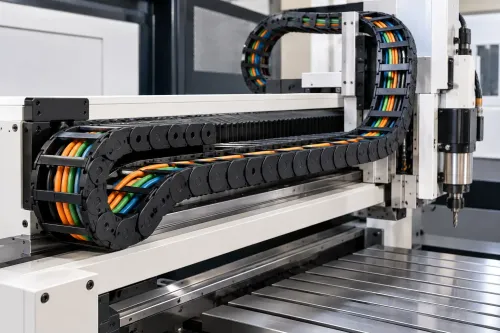
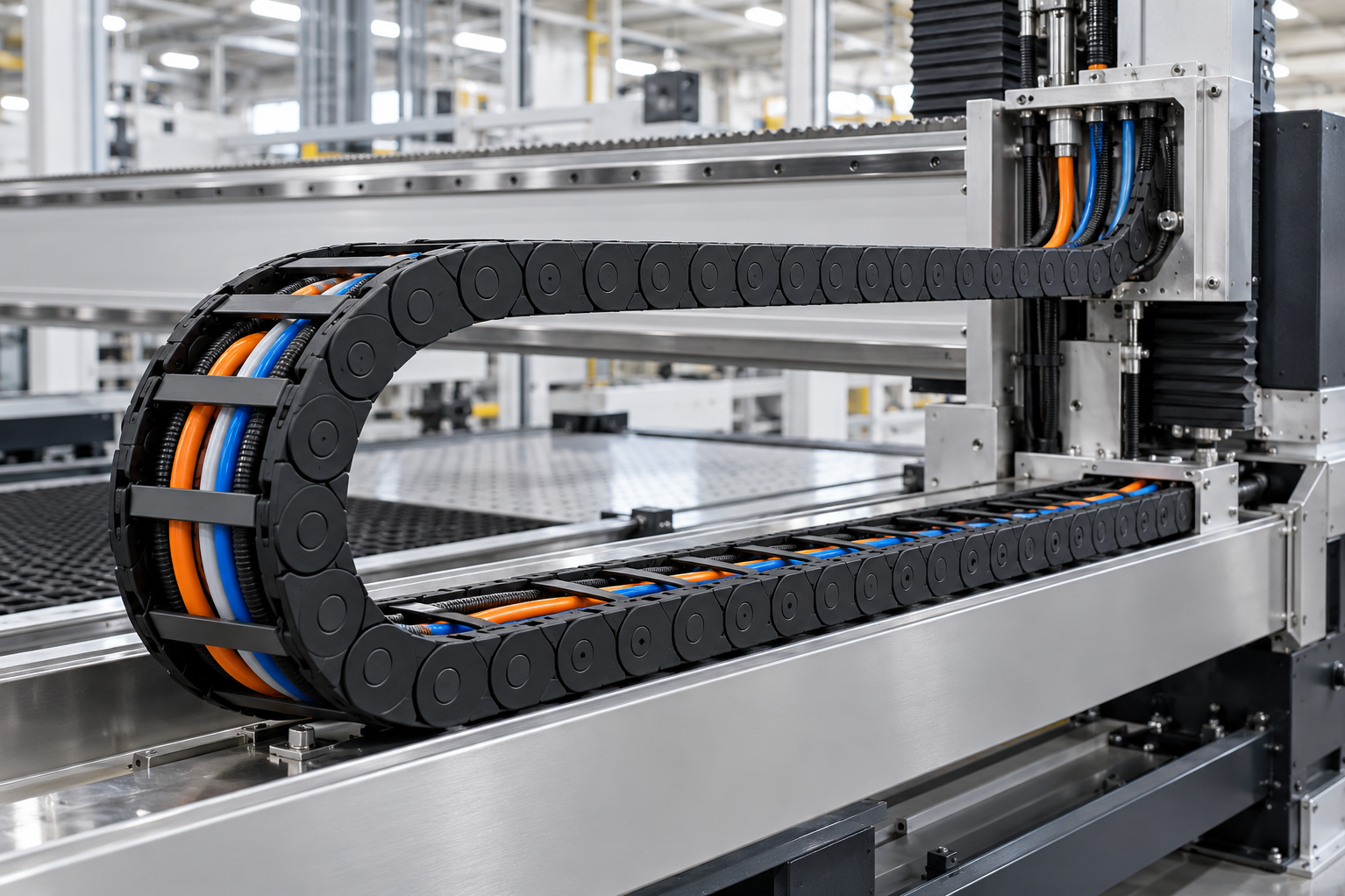
A Cable Drag Chain for Industrial Machinery provides a guided path for electrical cables, pneumatic tubing and other flexible services that must move with the machine.
Choosing the correct chain involves considerably more than finding one large enough to hold the cables.
Begin With the Cable Package
Before selecting the drag chain, identify everything that needs to travel inside it.
This may include:
- Power cables
- Control cables
- Encoder or feedback cables
- Data cables
- Pneumatic tubing
- Hydraulic hoses where suitable
- Other flexible machine services
The combined cable package influences the required internal dimensions and chain configuration.
Packing cables tightly into the smallest possible chain can restrict movement and increase mechanical stress.
Check Cable Bend Radius
Every moving cable or hose has a minimum allowable bend radius based on its construction.
The drag chain bend radius should be selected with the requirements of the installed cables in mind.
Ignoring this can lead to repeated over-bending during machine cycles, potentially shortening cable life.
For automation engineers, checking the cable specification before ordering the chain is therefore an important design step.
Separate Different Services Where Necessary
Power, signal, data and fluid lines may have different mechanical or electrical considerations.
Internal separators can help maintain organization and reduce unwanted interaction between services.
The exact arrangement depends on the machine and cable types, but a structured layout usually makes installation and future maintenance easier.
Do Not Overfill the Chain
Leaving suitable clearance allows cables to move naturally as the chain bends.
Overfilling can create rubbing, twisting and unnecessary stress.
The chain should also be sized according to the weight of the cable package, not only its cross-sectional dimensions.
A long travel carrying heavy cables creates different demands from a short, lightly loaded chain.
Travel Length Changes the Design
Short-stroke machine axes may use relatively straightforward drag-chain arrangements.
Longer travel distances can require additional consideration of chain support and operating configuration.
The designer should establish travel length, mounting positions and movement direction before ordering the component.
Installation Mistakes to Avoid
Several problems seen after commissioning originate during installation:
- Twisted cables placed inside the chain
- Insufficient cable clearance
- Bend radius below cable requirements
- Poor end fixing
- Cables crossing repeatedly inside the chain
- Excessive unsupported travel
- Chain interference with the machine frame
Testing the complete movement manually at the installation stage can reveal potential interference before full-speed operation begins.
Why Environment Matters in Coimbatore Industries
Industrial machinery in Coimbatore operates across textile, automotive, machining, pump manufacturing and general engineering environments.
Dust, oil, chips, heat and other process conditions may influence the required drag-chain construction and protection strategy.
SSB Industrial Solutions works with machine manufacturers and automation teams in Coimbatore and wider Tamil Nadu evaluating industrial motion and cable-management components.
When requesting a Cable Drag Chain for Industrial Machinery, providing the internal cable package, travel length, required bend radius, available installation space and operating environment can improve technical selection.
Cable drag chains are sometimes treated as minor machine accessories, but their role becomes obvious when an unsupported cable fails and stops an automated production line.
Designing cable management alongside the motion axis helps protect electrical and pneumatic connections while also making the machine cleaner and easier to maintain. For production equipment expected to perform thousands of repetitive cycles, that attention to detail can contribute directly to dependable machine operation.
Keywords